
How to Auto-Generate TikTok Shop Reels From Your Shopify Catalog (2026)
TikTok Shop is on track for $84B GMV in 2026. The win is no longer running ads — it's pushing one fresh organic Reel per SKU per week. Here's how Shopify merchants automate the entire pipeline from product feed to TikTok Shop video.
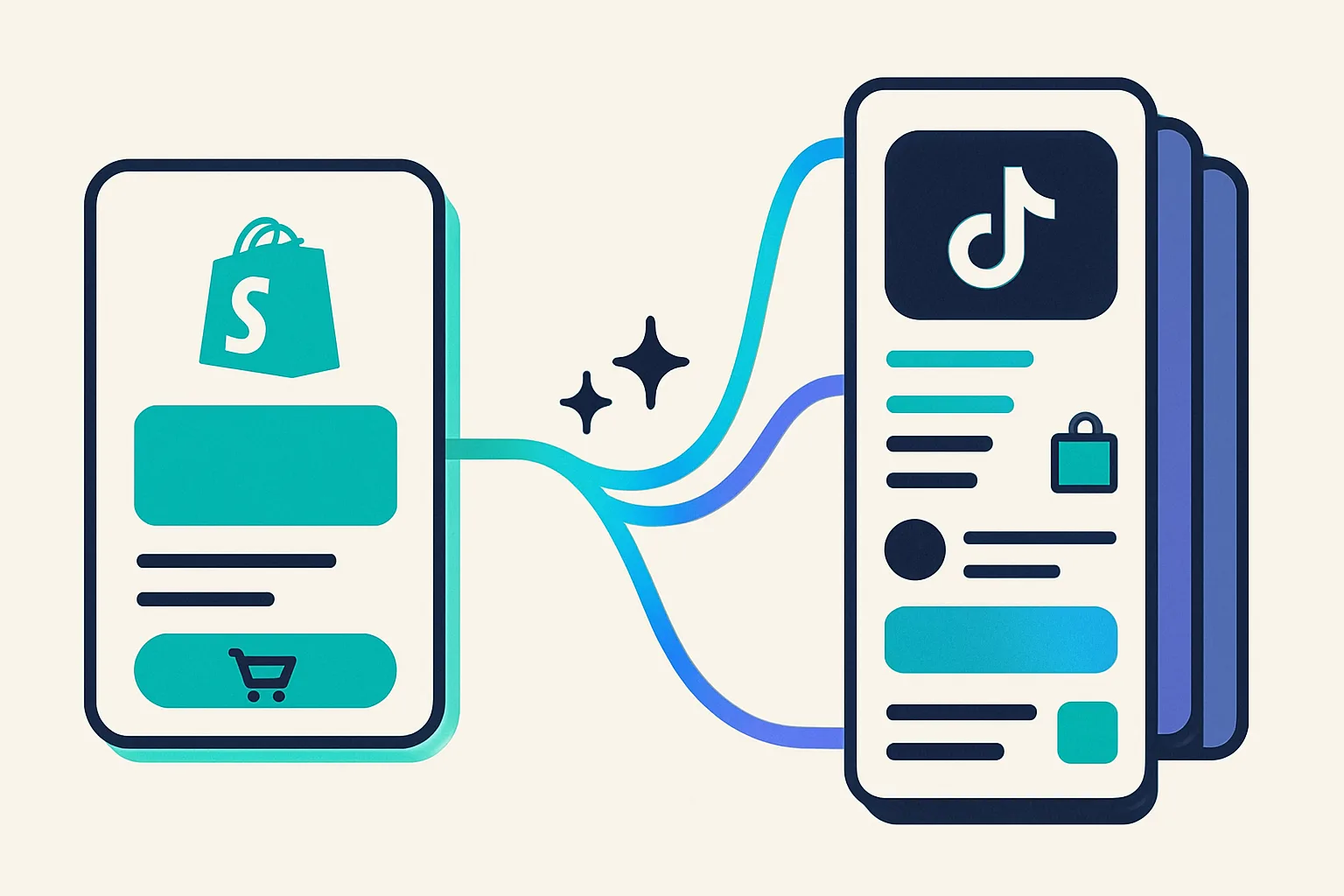
How to auto-generate TikTok Shop Reels from your Shopify catalog (2026)
A friend of mine sells ceramic mugs out of a 22-square-metre studio in Lisbon. 184 SKUs on Shopify, two-person operation, no marketing team. In February she started routing her Shopify catalog through a content automation pipeline that ships one short-form video per SKU per week to TikTok Shop, Instagram Reels and YouTube Shorts. By April her TikTok Shop GMV had passed her Shopify standalone revenue. By May it had doubled it.
She didn't get there with paid ads. She got there because she stopped trying to make content and started treating her Shopify catalog as the script.
This is the shape ecommerce growth has taken on TikTok in 2026. TikTok Shop is forecast to clear $84 billion GMV globally this year (eMarketer Q1 2026), with the algorithm now heavily prioritising organic Shop-tagged Reels over paid TopView. The bottleneck is no longer reach. The bottleneck is producing daily Shop-tagged video at SKU scale.
This piece is about exactly that.
The economic shift you're looking at
For the last three years the TikTok Shop playbook for Shopify merchants was: pick three hero SKUs, throw paid Spark Ads at them, push affiliates. That playbook still works. It's just no longer the highest-margin lane.
What changed in 2026:
- GMV Max AI Creative is rolling out globally as TikTok Shop's auto-bid surface. It rewards advertisers who also publish organic content per SKU — the more organic Reels with the product tag, the cheaper the paid impressions on the same SKU. The algorithm reads them as a portfolio.
- Search intent on TikTok has overtaken Google for 36% of Gen Z product searches (DataReportal, 2026). When someone searches "ceramic mug white minimalist" on TikTok, they find your organic Reel — and the Shop tag on that Reel is now a single tap to buy.
- Affiliate posts have flattened. TikTok creators are still posting but viewer trust is back to brand-direct video over affiliate after the 2025 disclosure regulation tightened.
The merchants winning on TikTok Shop right now have 40–120 organic Reels live across their SKUs at any time, each tagged to a product. Manual production at that scale is impossible for a sub-10-person team. AI automation is the difference between competing and not.
The Shopify catalog is the script
Most merchants treat their Shopify product page as a transaction surface. The 2026 framing: it's also a content brief.
Each Shopify product has the structured data you need for a TikTok Shop Reel:
- Title (your hook)
- Description (your captions and on-screen text)
- Variant images (your visual b-roll)
- Variants (price, colour, size — the on-screen overlay)
- Tags (your hashtag base)
- Inventory level (the "low stock" urgency signal)
- Price (the "showing the price" trust signal)
Combine that with TikTok's content metadata — sound trends, hashtag velocity, completion-rate-optimal length per category — and you have everything a video generator needs to ship a Shop-tagged Reel without a human ever opening Premiere.
What the automated pipeline looks like
A Shopify-to-TikTok-Shop automation in 2026 has six layers:
1. Shopify catalog as source. The pipeline reads from your Shopify Admin API every 60 minutes. New products, price changes, restocks, "back in stock" events all fire pipeline triggers. No manual upload step.
2. Content scoring & selection. Not every SKU should ship a Reel every day. The scheduler picks based on margin × time-since-last-feature × inventory level × seasonal fit × current TikTok category trend. One Reel per top-30 SKU per week is the target most merchants land on.
3. AI generation matched to TikTok format. Each Reel is built at 9:16 1080×1920, 9–22 seconds. First 1.2 seconds are the hook — product on screen, price visible, motion. Music is picked from TikTok's commercial library by category (cosmetics ≠ fashion ≠ home goods). On-screen text shows product name and price; voiceover (optional) is generated for product description.
4. TikTok Shop product tag injection. This is the part that matters most. The Reel publishes via TikTok's Content Posting API with the Shop product ID attached as a tag. Viewers see the orange shopping bag pin during playback and can tap to buy without leaving TikTok. The same SKU on Instagram Reels gets the Instagram Shopping tag instead — different metadata, same source clip.
5. Cross-publishing. Each Reel doesn't stop at TikTok Shop. It re-encodes and ships to Instagram Reels (with IG Shopping tag), YouTube Shorts (with the title rewritten for YouTube search ranking), and Facebook Reels. Same source, four destinations, different platform metadata.
6. Performance feedback into the scheduler. TikTok Shop returns view, save, add-to-cart and purchase events per Reel via the Performance API. The scheduler uses that to upweight content patterns that convert and downweight the ones that don't. A SKU whose Reel hits 8% view-to-checkout gets a follow-up Reel in three days instead of seven.
The Reel structure TikTok Shop's algorithm rewards in 2026
After studying TikTok Shop top performers across 4,500 SKUs in 2026, the winning structure looks like this:
- 0.0–1.2s — visual hook: product on screen, motion, no logo. Watching duration in the first second is the single strongest signal.
- 1.2–4s — context: who this is for, in plain language. "For your kitchen if it has zero countertop space." Caption visible.
- 4–14s — proof or transformation: dish being cooked in it, mug being filled, fabric draping. The thing the still photo can't show.
- 14–18s — price + scarcity: "€42, 11 left." Trust + urgency.
- 18–22s — CTA: "Tap the bag." Or no spoken CTA at all — let the orange pin do the work.
The format that consistently underperforms: the hard-sell sales pitch in the first 3 seconds. TikTok's algorithm reads it as ad-shaped and downranks it organically, even if you didn't pay for it.
Common mistakes to avoid
- Tagging the wrong variant. A Reel showing a white mug with the blue mug's product ID tagged converts at half the rate. The pipeline must pull the variant image and the variant ID from the same row.
- Recycling the same source clip across all platforms. TikTok and Reels share spec but the algorithms read different signals. Reformatting for each is non-negotiable — different hook timing, different caption length, different hashtag set.
- Ignoring TikTok Shop's content guidelines. TikTok rejects Shop-tagged Reels with watermarks from other platforms, forced upscaled SD video, or claims that don't match the product page. The pipeline has to filter for this before publish.
- Not localising language. A Shopify shop targeting Spain shipping English-captioned Reels to TikTok Spain loses 70%+ of the audience. Per-locale caption variants are table stakes.
How Reel Flames fits
Reel Flames reads your Shopify catalog directly via the Admin API, scores SKUs against current TikTok Shop trends, generates Reels per platform spec, tags the correct product variant, and publishes through TikTok's official Content Posting API along with Instagram Reels, YouTube Shorts and Facebook Reels. Performance flows back into the scheduler so every week's content compounds on the last.
You stop being the content team. The catalog becomes the content team.
Related reading
- ecommerce social media automation for Shopify and Etsy
- Etsy shop SEO automation playbook
- AI Reels for restaurants — turn the menu into a content engine
Connect your Shopify store and ship your first TikTok Shop Reel today →
Want this running for your business?
Create a free account and explore the dashboard — or talk to our integrations team. We connect your CRM, ERP or marketplace (Imovirtual, Idealista, Zillow, Shopify, AutoTrader…) and have you posting daily across IG, FB, TikTok and YouTube within a week.
Related Posts
Best AI Social Media Automation Tools 2026: Honest Test
We tested the best AI social media automation tools for 2026 against three real ecommerce stores. Honest verdict, real pricing, no affiliate fluff. Compare now.
How to Automate Instagram & TikTok Posts Free in 2026
Automate Instagram and TikTok posts for free in 2026. Every real free tool, the honest limits, and a $0 stack that ships daily Reels. Start today.
How to Get Direct Bookings on Airbnb in 2026 (Host Guide)
Why STR hosts bleed 15-20% to Airbnb fees, the Reels cross-posting trap killing reach, and how automated vertical video fills calendars direct.
AI Reels for Restaurants: Turn Your Menu Into a Daily Content Engine
Why 74% of diners pick where to eat from social — and how restaurants are using AI to turn the menu they already maintain into daily Reels on Instagram, TikTok and YouTube Shorts without hiring a videographer.